Smart Coaching and Training | Business Support, Consultancy, Mentoring

Transforming Businesses and Lives | Coaching, Mentoring & Training for Excellence

  • Facebook
  • Instagram
  • LinkedIn
  • Twitter


+44 (0)7788425688 | [email protected]


  • Home
    • Coaching News
    • Our Clients
    • About Us
      • Our Team
      • Our Scope
      • Our Approach
      • Social Value
  • People
  • Diversity
    • Artificial Intelligence, Interculturality and Diversity
    • Diversity: Interculturality
    • Diversity: Neuro Diversity
    • Diversity: Cognitive Diversity
      • Profile
    • Diversity: Gender and Sexual Diversity
    • Diversity: Colonialism, Class, Nationality, Ethnicity, Race and Beliefs
    • Diversity: Generational Diversity
    • Diversity: Intersectionality
      • Diversity
  • We Offer
    • Coach
    • Speak
    • Train
    • Consult
    • Wellness at Work
    • Psycho-social Adult Development
  • Profile
    • Behavioural Preference Profiling with C-me
    • Career Preference Profiling with Benchmark
    • C-me comparison to other profiling tools
  • Speak
  • Coach
  • Train
    • Signature Corprate Training, Longer courses and Retreats
    • Workshops and Short Courses
    • On-Line Courses
  • Consult
  • Español
  • Contact

27/03/2026 By David Rigby

Finally: New rebels in Music

Finally: New rebels in Music

when youth rebellion took music away from the staid BBC

At the start of the 1960s , at least in the UK, popular music was in a pretty bad way. It was controlled by the marketing men and the young stars had do what they were told. Some rebellious music had started such as skiffle and The Twist.  There was no legal alternative to the BBC whose policy was to ignore such trends.  Light entertainment and big comedy shows such as ‘Round The Horne’ would often feature two musical breaks because the audience couldn’t concentrate for long.  Typically one would be a brassy song from a Musical or Standard, and the the other would feature some trio trying to turn a traditional song into jazz.  Radio Luxembourg and illegal offshore pirate radio would play the then emerging challenges to the BBC who finally introduced Pop radio in 1967.  

Until 1962 most popular music was catchy little tunes or big ballads all adhering to the same safe formula with an orchestra of ex World War 2 marching traditions.  Then there was the scramble to sign up any four people who could get together and form a group. And hence the British Invasion which challenged the status quo in the USA.

RAYE whose new music may contain hope
As at summer 2025, Music today, especially in USA is in the same position today. Identical  tunes by identical singers sticking to the same formulas as the 1980s. Only this time written by 17 writers or ChatGPT.  The mavericks have been British, Amy Winehouse and Adele being the classic examples. They would never have been home grown from the USA.
If you go into any café, restaurant or bar today they are playing music from 1960s, 70s, 80s and occasionally the 90s .  It would be unimaginable to have gone into a café in the 1960s and listened to the songs of 1910 and 1920.

Bad Bunny, Olivia Dean and RAYE

The Beatles in 1962

In the mid sixties music crossed over from having white people making sanitised versions of black music to the real thing , with Motown leading the way.  It has now become segregated again.  

Personally I still collect Cds (I got rid of the Vinyl years ago), though I think I only have two which were recorded this century.  And listen to new streamed music from Sabrina Carpenter, Taylor Swift and the slightly more original Chapelle Roan  and its totally derivative and safe (except for the provocative videos). Bring on Bad Bunny, at least it’s got some fire in it’s belly.  And find some new folks as original as the Beatles came to be.

Postcript: This article was written in summer 2025.  A lot has happened since then, at least for me: America is still loving the droning from  Lana Del Rey and Billie Eillish but elsewhere there is magic from Rosalia, Olivia Dean and above all RAYE. All these have rebelled against the management, particularly RAYE whose new album released on 27th of March got a 5 star review. It will become the third CD I have bought with music actually recorded in this century and like Rosalia cannot be considered as easy listening .  If you listen you too will have the challenge of which of her songs to practice for karaoke (answer none- they are all impossible). Where the music contains hope, and success comes to those strong enough not to follow their advisors requirement for safety.

Smart Coaching & Training associates are all rebels. They have carved their individual ways to the top by the force of their own convictions and personalities. Not being corporate means they are best position to challenge and advise the corporate,

Smart Coaching & Training works with over 30 associates, in four continents speaking 14 languages. Most raised and working in a wide range of cultures and living in a different place than where they were born . See our associates here.

Many of our associates are specialists in Diversity , Interculturality and related topics Read more here and here.

Written by David Rigby © 2026 Smart Coaching & Training Ltd

Filed Under: Being Confident, Change Management, coaching, Cognitive Bias, Emotional Intelligence, Global teams, Interculturality, leadership, Management, Managing Change, Mentoring, Personal Development, You and Your Career Tagged With: Communication, diversity, Interculturality, intersectionality, intuitive, performing, profiling, safespace, Smart Coaching & Training

13/03/2026 By David Rigby

Watch, Read and Live Interculturality with Samar

Watch, Read and Live Interculturality with Samar

Authenticity is key to creating memorable experiences

Marhaba! Welcome our new associate Samar Karam see her details here. Read her article about AI below.

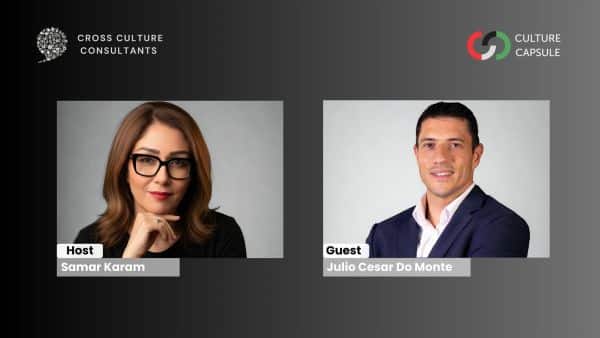
Her ‘Culture Capsule’ podcast on Tue, Mar 17, 2026, 8:00 AM CET features experts and thought leaders from around the world and each episode explores a unique cultural layer that helps you simplify and understand life in the UAE.

“In this episode of ‘Culture Capsule’, I welcome global business leader Julio Cesar Do Monte, a true international executive whose career has taken him across six countries and four continents. Julio currently serves as the Area Vice President Russia, Africa, Middle East and Turkey (RAMET) at Kenvue based in Dubai. Based on his impressive track record in leading multinational companies such as Kenvue, Johnson & Johnson, Boehringer Ingelheim, Unilever, and Danone in complex markets across the Middle East, Russia, Africa, and Turkey, Julio shares what it means to lead in multicultural environments where culture, communication, and adaptability shape success.

Culture Capsule is for expats, visitors, and curious thinkers, anyone who wants to understand the UAE beyond assumptions. Tune in, please click here for full details on how to Attend or on ‘Attend’ in order to be notified when we go live! It will be recorded

Tuesday 17th March 8AM CET or watch the recording
Our conversation explores:

• Life as a global expatriate and how constant relocation shapes perspective
• How international careers impact family life and identity
• Navigating culture shock
• Building trust through human-centered leadership and daily connection with teams
• Supporting employee mental health, resilience, and well-being in challenging times
• How AI tools are transforming productivity and the future of work
• Leading through uncertainty, with lessons inspired by leadership approaches in the UAE

Artificial Intelligence as used in Middle East

A recent LinkedIn posting by Samar Karam

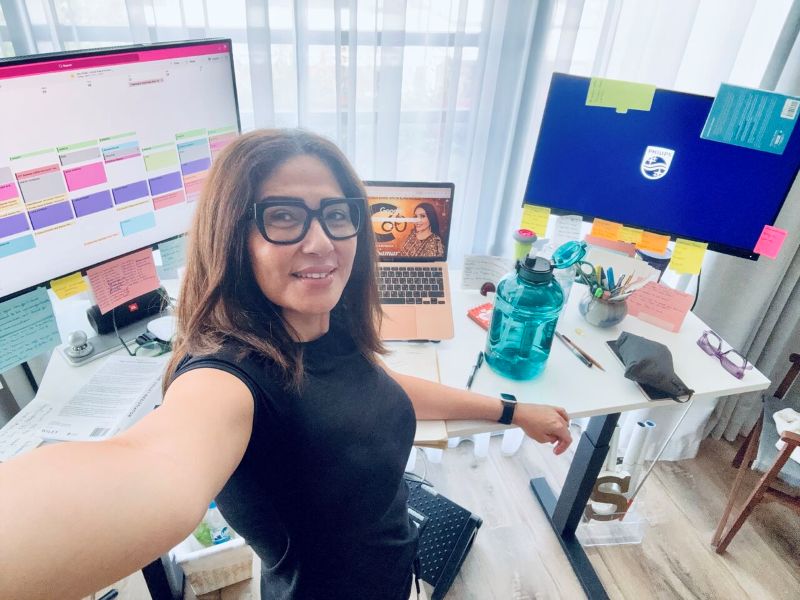
Samar Karam communicating with her fans (the world)

I thought I knew the strategy well enough. Working daily with culture, communication, and expats in the Arab world, I assumed that most AI platforms were more or less smart and equally helpful, interchangeable. I thought that I did my homework!
I was wrong.
If you work, live, visit, or lead in the Arab world, and you still think AI tools are culturally neutral, it’s time to think again. Or let me help with this article.

Why Cultural Intelligence Matters More Than “Smart AI” in the UAE?

In my work with expats, leaders, and relocating families in the UAE, I have learned one simple truth:

Communication fails here, not because people lack talent, but because cultural signals are missed.

That is why I paid close attention, perhaps later than I should have as a professional, to what kind of leadership AI is offering in my Arab world. When the UAE’s Office for Artificial Intelligence introduced the AI in the Ring Index, I did not initially pause to see it for what it truly was: not a technology ranking, but a reflection of cultural intelligence. At the time, I treated most AI platforms as a new tool with a strategy and maybe a threat.

Only recently through patience, research, careful observation, and conversations with trusted peers working in cultural intelligence—did my perspective sharpen. It became clear that not all AI systems lead to equal results when it comes to culture in the Arab world, and that distinction matters deeply in real professional and human contexts.

A Different Kind of Benchmark—and Why It Matters

Unlike typical AI benchmarks that focus on IQ-style problem solving or coding ability, the AI in the Ring Index asked a far more relevant question for life and work in the UAE: an an AI understand Emirati identity, values, and social reality well enough to communicate without causing friction?

To explore this, more than 400 culturally focused questions were designed, generating around 5,200 responses from 11 leading AI models. Model names were deliberately hidden so Emirati evaluators could assess the responses without brand bias—a practice very familiar to those of us who work in cultural assessment.

What Was Actually Measured (And Why Expats Should Care)

Emirati cultural experts evaluated the AI responses across seven deeply human dimensions:

  • Historical and national context
  • Creative and poetic expression
  • Emirati Arabic and dialect use
  • Cultural symbols and shared meanings
  • Social norms and etiquette
  • Social and religious sensitivity
  • Emirati values and ethics

In addition, a custom red-teaming approach pushed models into awkward, sensitive, or ambiguous cultural situations, the very moments where expats and organizations tend to struggle most. Outputs were monitored for bias, misunderstanding, overconfidence, or subtle disrespect. As a cultural trainer, I recognized this immediately: this is exactly how cultural competence is tested in real life.

Why This Matters for Expat Professionals and HR Leaders

For expats working in the UAE, especially in HR, leadership, relocation, and people-facing roles, cultural accuracy matters more than creativity or speed.

When drafting:

  • Arabic-facing emails
  • Ramadan or national occasion messages
  • Policy explanations
  • Leadership communication

The cost of language that is “almost right” can be high.

This is where Gemini emerges as a reliable reference point—not because it is perfect, but because it has been explicitly tested against Emirati cultural expectations. For many expats, Gemini functions best as a cultural calibration tool: “Is this how this would land locally?”

Why Emiratis Working With Expats Can Use ChatGPT Effectively

On the other hand, Emiratis and culturally fluent professionals working with expats often need something different:

  • Explanation
  • Reframing
  • Creative translation between worlds
  • Strategy and structure, often in English

Here, ChatGPT becomes extremely effective because cultural fluency already exists on the human side. The AI supports thinking and articulation it does not replace cultural judgment.

This distinction matters.

Gemini vs. ChatGPT in the Arab World: A Practical View

A clear pattern is emerging across the region: Gemini is becoming the stronger choice for Arabic-heavy and Google-centric workflows, while ChatGPT remains ahead in ecosystem breadth, integrations, and certain creative tasks

For HR, relocation, and leadership teams, this distinction matters far more than raw technical capability.

Arabic Language Quality: Breadth vs. Precision

Gemini

  • Supports 16+ Arabic dialects, including Gulf, Levantine, Egyptian, and Maghrebi
  • Produces Arabic that feels less translated and more native, particularly in Gulf contexts
  • Handles mixed dialect and Modern Standard Arabic (MSA) more naturally in day-to-day writing

ChatGPT

  • Has improved significantly in Arabic and Arabic–English mixed text
  • Still tends to default to more formal MSA
  • Can sound slightly off in Gulf tone, hierarchy, or social pacing

In practice: For everyday Arabic writing emails, HR announcements, internal communications Gemini often sounds closer to how people actually write and speak in the Gulf. ChatGPT remains strong but may require more cultural editing.

Cultural Fit: UAE vs. the Wider Arab World

Gemini aligns particularly well with Emirati and Gulf cultural norms, especially around:

  • Business etiquette
  • Religion-adjacent topics
  • Formality and restraint
  • Professional hierarchy

This makes it especially suitable for:

  • UAE-based organizations
  • Government-adjacent or semi-formal environments
  • Public-facing corporate communication

However, neither model fully captures the diversity of the wider Arab world. Beyond the UAE—into Saudi Arabia, Egypt, the Levant, or North Africa dialect carries deeper social meaning, and “neutral Arabic” can feel emotionally distant.

In these contexts, human cultural review is essential, regardless of the AI used.

Availability and Integration in the Region

Gemini

  • Fully available in Arabic via Gemini and Gemini Advanced
  • Deeply integrated into Google Search, Gmail, Docs, Sheets, Drive, and Maps
  • Especially practical for organizations already using Google Workspace across MENA

ChatGPT

  • Fully available across the UAE and GCC
  • Strong integration with Microsoft 365, Azure, and enterprise systems
  • Widely adopted across institutions and large organizations

Operational reality: Most organizations choose AI not only for language quality—but for where the tool already lives.

Where Each Tool Tends to Win

Gemini excels at:

  • Day-to-day Arabic writing and editing
  • Multi-dialect handling in Gulf contexts
  • Culturally aware Arabic search and chat
  • Seamless use inside Google tools common in MENA

ChatGPT excels at:

  • Broader third-party integrations
  • Microsoft-centric environments
  • Creative and strategic tasks (code, ideation, experimentation)
  • English-first work with occasional Arabic support

The Strategic Insight Most Teams Miss

AI does not fail in the Arab world because it lacks intelligence. It fails when organizations confuse linguistic correctness with cultural belonging.

Used thoughtfully, AI can:

  • Support clarity
  • Reduce friction
  • Accelerate communication

Used carelessly, it can:

  • Flatten nuance
  • Miss hierarchy
  • Undermine trust

In my humble opinion, the responsibility for cultural intelligence still sits with humans. That is the lens through which this conversation should continue.

Smart Coaching & Training works with over 30 associates, in four continents speaking 14 languages. Most raised and working in a wide range of cultures and living in a different place than where they were born . See our associates here.

Many of our associates are experts in AI and love it.

Many of our associates are specialists in Diversity , Interculturality and related topics Read more here and here.

Written by David Rigby © 2026 Smart Coaching & Training Ltd from content from Samar Karam
Filed Under: Being Confident, Change Management, coaching, Cognitive Bias, Emotional Intelligence, Global teams, Interculturality, leadership, Management, Managing Change, Mentoring, Personal Development, You and Your Career Tagged With: Communication, diversity, Interculturality, intersectionality, intuitive, performing, profiling, safespace, Smart Coaching & Training

Contact Info

+44 (0)7788 425688
[email protected]

Smart Coaching & Training Ltd, Reg No 08362126

  • Facebook
  • Instagram
  • LinkedIn
  • Substack
  • Twitter

Recent Featured Posts click on pic to see title and connect to article

They say it’s your birthday

How I discovered Meaning and Purpose

Social Media

We mostly post to David Rigby’s Linked In  and  Facebook

Instagram

My Intercultural Birthday https://www.smartcoachingtraining.com/they-say-its-your-birthday
Just the truth and said better than could and it needs saying over and over again
How I discovered Meaning and Purpose

Facebook

Copyright © 2026 Smart Coaching & Training All Rights Reserved · Privacy Policy · Terms of Service · Privacy Settings