Smart Coaching and Training | Business Support, Consultancy, Mentoring

Transforming Businesses and Lives | Coaching, Mentoring & Training for Excellence

  • Facebook
  • Instagram
  • LinkedIn
  • Twitter


+44 (0)7788425688 | [email protected]


  • Home
    • Coaching News
    • Our Clients
    • About Us
      • Our Team
      • Our Scope
      • Our Approach
      • Social Value
  • People
  • Diversity
    • Artificial Intelligence, Interculturality and Diversity
    • Diversity: Interculturality
    • Diversity: Neuro Diversity
    • Diversity: Cognitive Diversity
      • Profile
    • Diversity: Gender and Sexual Diversity
    • Diversity: Colonialism, Class, Nationality, Ethnicity, Race and Beliefs
    • Diversity: Generational Diversity
    • Diversity: Intersectionality
      • Diversity
  • We Offer
    • Coach
    • Speak
    • Train
    • Consult
    • Wellness at Work
    • Psycho-social Adult Development
  • Profile
    • Behavioural Preference Profiling with C-me
    • Career Preference Profiling with Benchmark
    • C-me comparison to other profiling tools
  • Speak
  • Coach
  • Train
    • Signature Corprate Training, Longer courses and Retreats
    • Workshops and Short Courses
    • On-Line Courses
  • Consult
  • Español
  • Contact

09/01/2023 By David Rigby

Productivity and Wellness: Confidence, Communication, and Motivation

Productivity and Wellness: Confidence, Communication, and Motivation

Productivity + Wellness = money

I am a great fan of the podcasts and programmes broadcast by BBC Radio 4 in UK. on these programmes I have noticed a great interest in the Productivity industry and the Wellness industry and how they are interconnected.  To succeed in both of these, prerequisites are Confidence, Communication and Motivation. And together they can lead to collective effervescence.

Collective Effervescence

I have worked in 22 countries and accordingly the norms of behaviour are very different. Likewise I am aware that learning to communicate with people in a language is not their native one (or my native one) requires special skills. It helps to understand the constructs of their native language. Don’t assume that because someone comes from or lives in a particular country will be have in the stereotypical way. The majority of people in any country do not conform to national stereotypes and the best way of building relationships with anyone is by building cognitive diversity skills as well as intercultural skills.

Motivation is the first step

Unless you are motivated you won’t do anything. Getting motivated to get up in the morning is the first step to doing anything. Motivation leads to action and that’s the only way to get to results. Motivation can help get you better at something. Personally I struggled all my life with not speaking clearly and when I started my first job I was too shy to talk to people. I became motivated to improve my communication skills. Understanding my Cognitive Communication Profile helped me recognise that people prefer to communicate differently. I took the plunge to take public speaking classes. My confidence in speaking gradually improved, one baby step at a time.

unlease your motivation click to see more
ace your communication click to see more
confidence: strut your stuff click to see more

Confidence to speak to strangers

If you talk to a stranger at a meeting or party – what’s the worst thing that can happen? They ignore you. And you would be no worse off than if you did nothing . At best you can get a new friend, lover or work. Having the confidence to try new things, the confidence to fail and learn are skills on the road to success.

Motivation, Confidence, Communication – two ways to learn

Confidence, Communication and Motivation are fundamentals to success, to be productive and be well.   We are running one day courses on all three in Morocco in March. Why not join us in the sun.  See more here  or click through on the icons above right. Or if not, the courses are available on line. here

Read more here

At Smart Coaching & Training we have a diverse team of 20 associates in four continents speaking 11 languages. We pass the tests on diversity for sex/gender, race/ethnicity, sexuality, education, class, generation. and fail on the boring-interesting spectrum. See our associates here

Written by David Rigby © 2023 Smart Coaching & Training Ltd

Filed Under: Being Confident, coaching, Communication, Emotional Intelligence, Mentoring, Mindset, People Development, Personal Development, Training, Wellbeing Tagged With: Emotional, feedback, feeling, intuitive, Jung, logical, profiling, psychological safety, Smart Coaching & Training, Stockholm, thinking

10/11/2022 By David Rigby

Cognitive: the most important type of Diversity

Cognitive: the most important type of Diversity

Are you dancing? Are you asking?

What’s the difference between being asked to the dance and being asked to dance ?  This is a well established and good example of explaining the difference between Diversity and Inclusion.

Go sort these women’s issues

Typically, the pale, male and stale brigade announce they have a woman or an LGBT person on the board and they are tasked with dealing with HR or other soft topics and never get asked their opinion let alone to manage with anything else as that’s straight man’s work.   And it ticks all the boxes of their Diversity policy.   None of the ticks in the Inclusion box.

People like me, people like us

Most organisations typically like to recruit ‘people like us’ so they wont challenge the status quo. Most individuals (and many organisations) have cognitive dissidence – not even realising that have biases let alone doing something to counter it.

You are black – therefore your politics are…

The furore about a recent ex UK prime minister’s non-white chancellor demonstrated that colour is immaterial to diversity if all about you were also educated at Eton. Another politician said , in effect , “All black people think like this (or should)”- unless they are from a privileged group and are not, or much less, oppressed. Some people think “All Spanish people behave like this”- but depending on social status or location may not. – ‘some’ Spanish people may, most probably don’t .

How many stereotypes do you belong to?

Stereotypes are the biggest disaster – for any category the majority just don’t fit because they also belong to many other types which may be more prevalent.

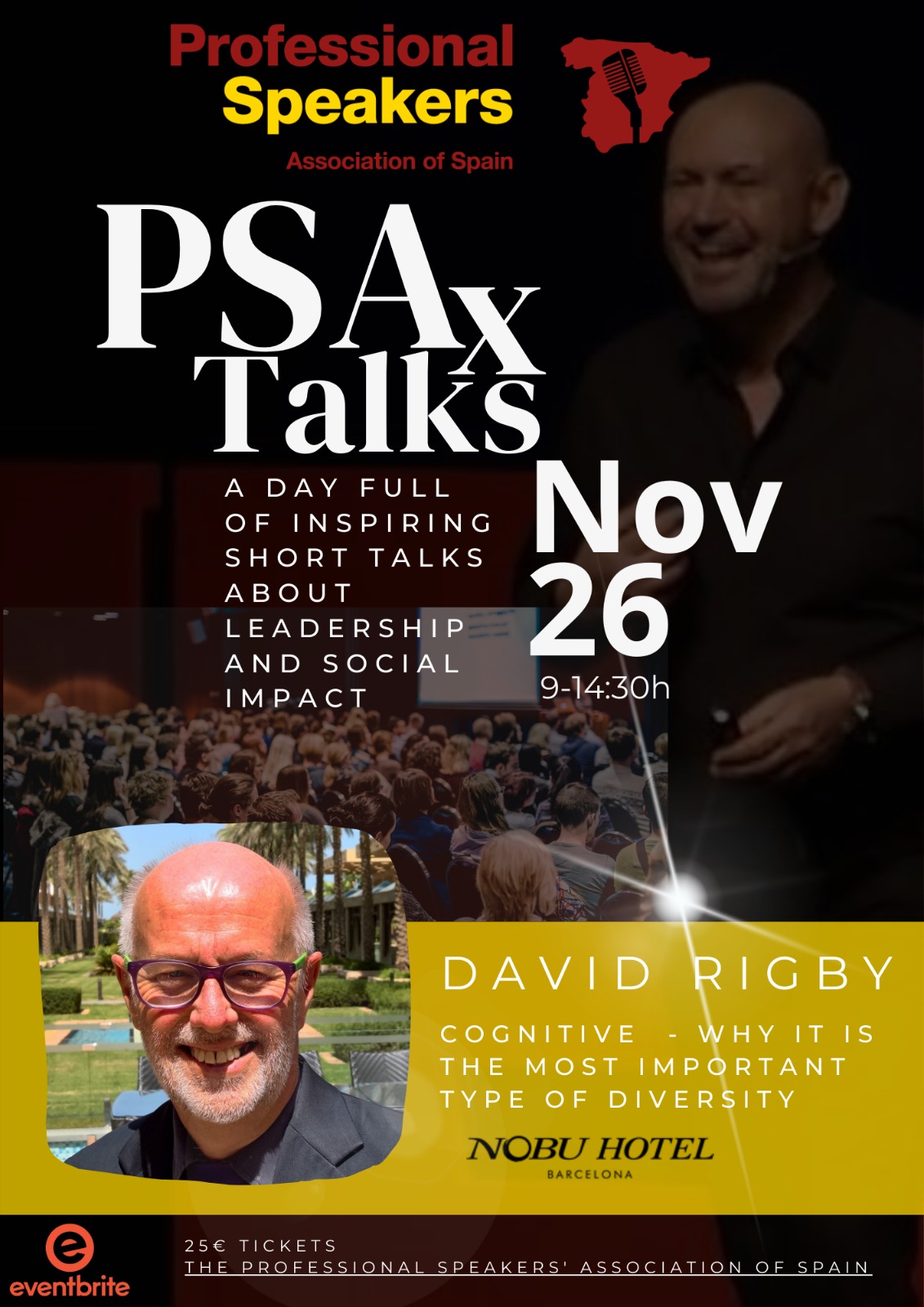
David Rigby will be presenting at PSAx talks 26 November 2022 in Barcelona (see below)
David Rigby was an expert speaker in Jersey (UK) in Otober
Hear SCT associates David Rigby, Jessica Breitenfeld, Caroline Dreami, and Ian Gibbs and many other experts at this Barcelona event. – details below

Gender and Sexuality – sorted – so we are diverse.

There are other types of diversity except gender and sexuality. And yet most of the talk is about these two. The woman’s lobby and the LGBT+etc lobbies have ensured that. And coming up a good third is Race/Ethnicity and country of origin. Is dealing with these enough ? – many organisations dont know any better.

Class, education type and education level, country of residence, age (generation), religion, culture, organisation all are different spectrums of diversity. 

Neurodiversity and Worldview

And worthy of inclusion are NeuroDiversity and Worldview.  Neurodiversity is used to explain the diverse ways of thinking, learning, processing and behaving. People who think differently can come up with different ideas. ADHD, Autism, Dyspraxia, Dyslexia, Dyscalculia, Dysgraphia, and Tourette’s syndrome are all examples of neurodiverse conditions.

Worldview is about values and cultural behaviours. The concept worldview usually refers to an interpretation of reality that provides an overarching framework for the constitution of the world or the cosmos. Various belief systems, religions, ideologies, and science itself are examples of worldviews that contain differing pictures of the world. All of us have different pictures – the more the pictures differ the more diverse the team.  For example, the family is more important than the individual. Power is more important than doing the right thing.

Looking at different perspectives and listening to others – to make more money

The point about having a diverse and fully included team is that it looks at things from different perspectives.   And research shows over and over that organisations with the most diverse teams are the most successful and profitable.   Many people think they are diverse until someone challenges them with a different opinion.  

Those who think logically typically take a different perspective compared with those who think emotionally.  The extravert thinks differently from the introvert.  Having a team or organisation with all these categories in various of the four combinations are the most powerful diverse teams you can have.   This is called cognitive diversity.   

Cognitive : Introvert or Extravert ? Logical or Emotional

Working with people who think and communicate the same way as you, regardless of their other diverse characteristics, will not get you the benefits of a diverse team. To get the benefits, above all, you need a team that is cognitively diverse. Just invite all the combinations both to the dance and also to dance . Read more here

At Smart Coaching & Training we have a diverse team of 20 associates in four continents speaking 11 languages. We pass the tests on diversity for sex/gender, race/ethicity, sexuality, education, class, generation. and fail on the boring-interesting spectrum. See our associates here

Written by David Rigby © 2022 Smart Coaching & Training Ltd

To attend the Professional Speakers Association (Spain) ‘s PSAx event in Barcelona on November 26th click here

Filed Under: Communication, Emotional Intelligence, Mentoring, Mindset, News, Personal Development, Wellbeing Tagged With: Emotional, feedback, feeling, intuitive, Jung, logical, profiling, psychological safety, Smart Coaching & Training, Stockholm, thinking

09/05/2022 By David Rigby

LEGO®Serious Play®in practice

LEGO®Serious Play®in practice

How can I build my team?

The serious business of play can be used to help individuals and organisations resolve issues and find a way forward.  Techniques such as Team Coaching and Constellations have been used for many years to enable innovative thinking to be creative outside of the conventional box. Now, you can take a box of Lego and, under guidance, use the bricks to help find a way forwards.

How can I resolve team issues?

 In LEGO®Serious Play® sessions, individuals construct their own models for specific topics and learn from translating their 3D creation into words, a surprisingly insightful process, noting how different people interpret the same instructions. Many people find it easier to express their emotions through a third party or vehicle rather than talk about them directly, and having a model facilitates this. There are also opportunities to model a future by building co-operatively, to allow the quieter ones to contribute at equal level as their more assertive counterparts.

Ian Gibbs: simple models tell great stories . Barcelona April 2022
One of the groups at Jessica Breitenfeld’s H2BU studio Barcelona

How can I plan my company’s future?

In April in Barcelona, Spain, Smart Coaching & Training ran a successful event with LEGO®Serious Play Certified Practitioners, Marta Odriozola and Ian Gibbs to demonstrate how Lego Serious Play works. Participants learnt how simple small pieces of coloured plastic can be transformed into a powerful way of thinking that can cross conventional boundaries and act as a catalyst for producing ideas that were buried inside them waiting to be discovered. You can see photos of how the individuals bonded and confidently told their stories to their team members.

LEGO®Serious Play® Workshops

SCT are now proud to offer a series of three five hour workshops to complete your understanding.

You can see them here

https://www.smartcoachingtraining.com/wp-content/uploads/2022/05/LSP-Team-Strategy.pdf

https://www.smartcoachingtraining.com/wp-content/uploads/2022/05/LSP-Company-Strategy.pdf

https://www.smartcoachingtraining.com/wp-content/uploads/2022/05/LSP-Identity.pdf

See all our workshops and short courses: https://www.smartcoachingtraining.com/what_we_offer/workshops-and-short-courses

And our longer Signature Corporate Training Courses: https://www.smartcoachingtraining.com/what_we_offer/signature-corporate-training-longer-courses-and-retreats

At Smart Coaching & Training we coach and mentor according to client’s need, matching the client to appropriate associate based on needs including location and language.

Written by David Rigby © 2022 Smart Coaching & Training Ltd

Filed Under: Communication, Emotional Intelligence, Mentoring, Mindset, News, Personal Development, Wellbeing Tagged With: Emotional, feedback, feeling, intuitive, Jung, logical, profiling, psychological safety, Smart Coaching & Training, Stockholm, thinking

09/12/2021 By David Rigby & Martin Kubler

Duck Ramps

Duck Ramps

What’s my role as a mentor?

Before going to Oman to deliver training to Ministry of Transport in December 2021 , I was enjoying a fine spring morning walking around my neighbourhood in Stockholm and preparing for an upcoming Zoom with one of my Institute of Hospitality mentees, when I stumbled upon this contraption on the side of a small canal, which runs through a park behind my apartment:

What’s that sloping metal sheet for?

Initially, I wasn’t sure what the purpose of the sloping metal sheet was that was attached to the side of the canal. Just as I was looking at the ramp and scratching my head, a duck mother and her recently born ducklings drifted past and paddled to the ramp. Mother duck hopped out of the canal with a swift jump, but the little ducklings used the metal ramp to reach the shore.
I remember thinking, that it says a lot about my new neighbourhood that local authorities go to the trouble of installing duck ramps, so little ducklings (or older ducks, which feel less energetic), can enter and leave the water effortlessly, but I also realized that the image fairly aptly symbolizes my role as a mentor

Adapting to mentee´s needs

I feel strongly that, just as every mentee’s circumstances are different, a mentor’s approach also needs to adapt and that “one size fits all” isn’t a good approach. For a mentor – mentee relationship to be successful and produce results, both parties need to, at least broadly, align, which also means that, depending on a mentee’s journey, he or she should work with more than one mentor. It’s important for a mentor to understand the stage a mentee is currently at to be able to provide the right guidance.

Danger- Mashed potatoes , no?

Equally, a mentor doesn’t just need to understand the mentee’s industry and circumstances, but also the finer details of why the mentee is looking for guidance. “Mentee pleasing” sounds like a nice thing, but isn’t really helpful in the long run. A mentor’s a short-time guide, not a permanent advisor, and he or she cannot mentor, say, an entrepreneur from the pre-start-up phases to successfully running every aspect of a multi-million-dollar business.

Martin Kubler training for Ministry of Transport Oman December 2021
Duck Ramp – Stockholm

You might be a start-up specialist and a sales expert, but have no idea of the intricacies of human resources or how to set up an ERP system. It’s best to be upfront with mentees and explain where you can and cannot add value. Beware of people who try to add value everywhere or you’ll end up with an ERP system that mashes potatoes (I don’t know too much about ERP systems, but I’m pretty sure that they’re not supposed to mash potatoes).

Swimming without arm floats

Personally, I’ve got things figured out – and that’s also where the duck ramp from earlier on comes into play again: I help mentees get into the water smoothly and safely and learn how to swim. Once they know how to use the ramp and can swim comfortably without arm floats, I might wave them a fond farewell and introduce them to a mentor who’s better placed to help them with the journey ahead. Unless, of course, you’re talking marketing planning, communications, digital, or one of my other specialties, in which case I might just jump into the water myself and paddle alongside my mentee for a bit longer.

The ‘Number One’ factor in growing up to be a Swan

Mentors, essentially, are duck mothers or maybe Swan mothers. We’ll make sure our mentees paddle into the right direction, but we’ll also know that the time will come when our mutual journey ends and when a mentee might need different, fresh, specialist guidance.

If you’re a mentor, look around you, and you’ll soon find your duck ramp – even if your local authorities aren’t as duck friendly as mine. If you’re a mentee looking for a mentor, don’t agree to a ramp when what you really need are water skis or a 500 horsepower outboard motor, but also don’t buy a fancy yacht when you haven’t yet learned how to row a dinghy boat.

At Smart Coaching & Training we coach and mentor according to client’s need, matching the client to appropriate associate based on needs including location and language.

Written by Martin Kubler © 2021 Smart Coaching & Training Ltd

Filed Under: Communication, Emotional Intelligence, Mentoring, Mindset, News, Personal Development, Wellbeing Tagged With: Emotional, feedback, feeling, intuitive, Jung, logical, profiling, psychological safety, Smart Coaching & Training, Stockholm, thinking

02/07/2021 By Jessica Brietenfeld and Simon Grayson

Make Your Team Psychologically Safe

Make Your Team Psychologically Safe

Teams that Trust – Triumph: Why Psychological Safety matters to your bottom line


Remember when you were on a team and really enjoyed it. What were the meetings like and how did the group communicate? Which team did you most enjoy being in? Which team that you were a part of was most effective? Were you more effective when you felt safe to be yourself and express yourself?

Being on a team can be a dream or a nightmare.

All of us have mixed experiences when being part of a team or group or when leading them. What makes an efficient team? Talent alone is nowhere near enough of an attribute to make an effective team. It has been proved through various scientific research that the best teams share ideas.in a safe atmosphere where failure is viewed as progress- when a member of the team feels like it is okay to share an idea without knowing if it will in fact work out. In fact they are willing to share the acorn of an idea knowing that others will help it grow and develop it to something better.

Using one´s strengths

On an ideal team, each person is willing to speak their truth and give feedback when things are good, bad or indifferent. They speak humbly with empathy,,are open to feedback and opportunities to learn and have a desire to improve. Team members are willing to speak up if and when they spot a potential risk. What they spotted may be incorrect, but mistakes are not held against each other. Each team member realises that they need to include, listen and challenge others to be more effective. The leaders of these teams listen in order to learn, grow and develop the team. So that they can do more with less stress.

Think of teams that you’ve experienced, inside or outside of work, that keep quiet, don’t share ideas and avoid speaking up, even when they know the answer or see a problem looming.

Danger- imminent disaster, no?

Imagine a ship where the captain knows they will hit an iceberg but they fear upsetting the owner of the ship and losing their jobs- in case they are wrong.
Imagine a IT guy having had the experience at a previous job of a similar project and knowing what went wrong but not having the safety to share this information because of the hierarchy on the team.
Wouldn’t you want your team to help make you more successful? You must give them permission to fail and to try again.

Psychological Safety Expert- Simon Grayson
Psychological Safety Expert- Jessica Breitenfeld

The people in these teams can be merciless if someone makes an error The result is that no one speaks up, no-one shares ideas and you became extinct like Kodak film. Leaders of teams like this listen only to correct, react and delegate. These companies become Irrelevant in today’s VUCA (volatility, uncertainty, complexity, and ambiguity) world without innovative team.which ultimately drives ‘safe’ behaviours that don’t maximise performance, rarely create fresh ideas and never surpass targets. The leaders of these teams listen in order to respond, fix and tell. This team will never fulfil its potential because the team has low Psychological Safety. That sense of not feeling safe and supported within a team or group gets in the way of performance, innovation, learning, and personal success.

The ‘Number One’ factor in team effectiveness

The NUMBER ONE factor in team effectiveness is “Psychological Safety”.
This insight is the result of almost 30 years of research by Amy Edmondson, at Harvard Business School, supported and reinforced by an extensive two-year research programme (Project Aristotle) across 15,000 employees at Google read about Project Aristotle in The New York Times magazine).

At Smart Coaching & Training we measure team effectiveness across four dimensions:

Attitudes to risk and failure:
• the degree to which it is permissible to make mistakes
Open conversations
• the degree to which difficult and sensitive topics can be discussed openly
Willingness to help
• the degree to which people are willing to help one another

Inclusivity and diversity
•
the degree to which people can be themselves, and be welcomed for this. The degree that others can be different and the tolerance for it.

How Psychologically Safe is it to Spill the paint or Spill the beans? Wales, UK Photo by David Rigby

You can be do the ¨AQai Adaptability Quotient test to see how your team members respond under stress and in change situations and then our coach can help you with a plan to increase your team’s Adaptability IQ score so that it is agile and able to keep up.

We deliver coching support, diagnostic tools and a Psychological Safety Workshop to assess your current level of Psychological Safety and help you plan to improve it

Workshops will train a ¨Yes, And¨ mindset, will have role plays and improvisation LAB Experiences with Serious Games where your team practices the mindset of an adaptive team that supports one another.

Your team practices feedback sessions, how to present information and how to create rapport so they approach the team prepared and with confidence that they are delivering their ideas clearly.

Team that trust – triumph.

See “Make your team Psychologically Safe Workshop” Here and help build tthat atmosphere of trust, trial and triumph with interactive, dynamic training .

Written by Jessica Brietenfeld and Simon Grayson , © 2021 Smart Coaching & Training Ltd

Filed Under: Communication, Emotional Intelligence, Mentoring, Mindset, News, Personal Development, Wellbeing Tagged With: Emotional, feedback, feeling, Harvard, intuitive, Jung, logical, profiling, psychological safety, Smart Coaching & Training, thinking

  • « Previous Page
  • 1
  • 2
  • 3

Contact Info

+44 (0)7788 425688
[email protected]

Smart Coaching & Training Ltd, Reg No 08362126

  • Facebook
  • Instagram
  • LinkedIn
  • Substack
  • Twitter

Recent Featured Posts click on pic to see title and connect to article

They say it’s your birthday

How I discovered Meaning and Purpose

Social Media

We mostly post to David Rigby’s Linked In  and  Facebook

Instagram

My Intercultural Birthday https://www.smartcoachingtraining.com/they-say-its-your-birthday
Just the truth and said better than could and it needs saying over and over again
How I discovered Meaning and Purpose

Facebook

Copyright © 2026 Smart Coaching & Training All Rights Reserved · Privacy Policy · Terms of Service · Privacy Settings